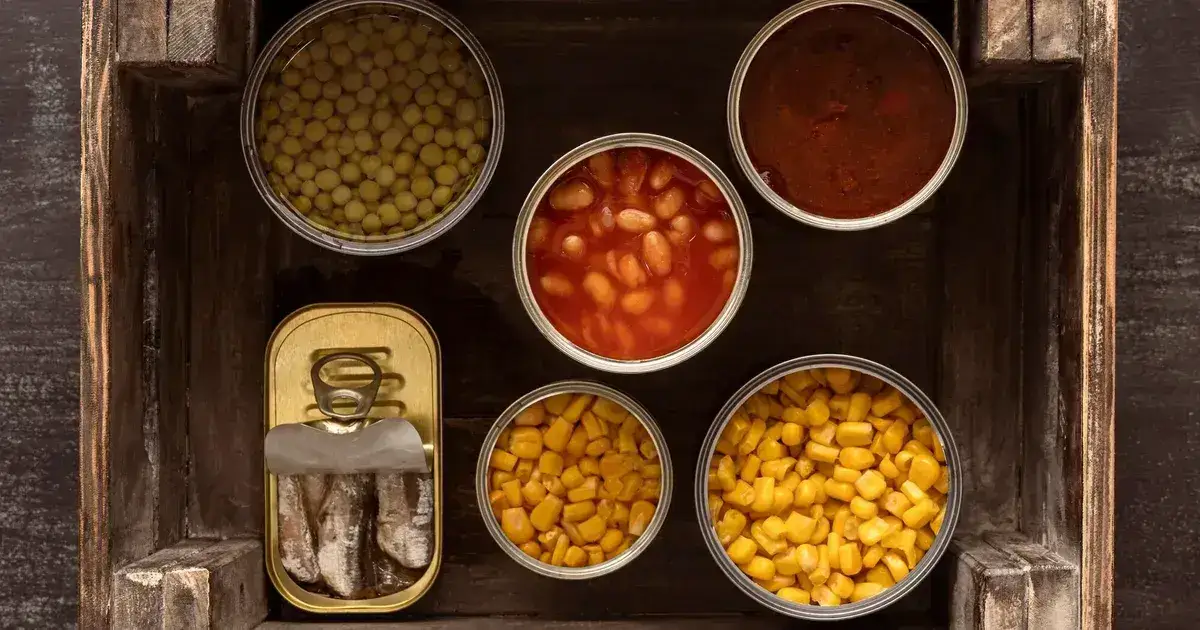
Freeze-Dried vs Canned Emergency Food: Which to Choose in
Build your personal emergency plan
Free, no sign-up, takes 5 minutes.
You open the emergency kit you put together two years ago. Your kids are looking at you, hungry, and the power is out. Freeze-dried meals need water you can’t spare. Cans are too heavy for a backpack. The choice between freeze-dried vs canned emergency food isn’t as obvious as it looks, and there’s one calculation almost nobody runs correctly.
Here’s the comparison with real numbers: what they actually cost per calorie, how much water freeze-dried meals demand, which one survives a hot garage better, and the combination that actually works.
Freeze-dried and canned food: how they really differ
The freeze-drying process uses sublimation at low temperatures. Water moves directly from ice to vapor without passing through liquid, removing about 98% of moisture. This preserves 90-97% of macronutrients and minerals, according to research done for space mission food. Canned food gets sterilized at 240-265°F for 20-40 minutes, killing microorganisms and spores.
But the key difference isn’t shelf life. It’s how you eat them.
A freeze-dried pouch weighs 3-5 oz and needs 12-20 fl oz of potable water to rehydrate. A can weighs 7-14 oz with the liquid included and you eat it straight from the can. That difference seems minor until you do the math on water, cost, and weight for several days.
How long do they really last? The shelf life manufacturers don’t talk about
Freeze-dried manufacturers claim 15-25 years under optimal conditions: constant temperature below 75°F, dark, sealed pouch. In an American garage with summer temps above 100°F, the realistic expectation drops to 10-15 years. Users on prepper forums report puffy pouches after 2-3 years in unconditioned storage with peaks above 105°F. Once the pouch is open, you have 24-48 hours before it absorbs humidity and the texture goes south.
Cans carry a “best-by” date of 2-5 years, but that’s not an expiration date. Per USDA Food Safety guidance, intact cans are safe well beyond the printed date, though they may lose texture, flavor, and some nutritional value. Vitamin C drops 50-70% after 2-3 years, and lipids slowly oxidize. But experienced users report cans 6-8 years old in perfect organoleptic condition stored in interior pantries.
There’s a nuance that matters: the metal can protects against extreme heat better than the multilayer aluminum pouch on freeze-dried meals. In a Phoenix kitchen during August, the manufacturer’s 25-year promise is optimistic.
Safety warning: Never eat a can that is bulging, has deep dents along the seams, or shows liquid leaks. These are potential signs of Clostridium botulinum contamination. When in doubt, discard. The risk isn’t worth it.
What does emergency eating actually cost? The cost-per-calorie no one calculates
Canned food runs $1.80 to $3.50 per 500 kcal. Freeze-dried meals cost $7 to $12 for the same calorie count. For a family of 4 over 14 days (about 112,000 kcal total), the gap is brutal: $250-450 in cans versus $1,000-1,800 in freeze-dried.
Comparing “per pouch” or “per can” is misleading: a pouch might have 400 kcal and a can of beef stew 600. Cost per calorie is the only number that matters.
Freeze-dried food pays for three things: industrial sublimation (an energy-intensive process), nitrogen-flushed packaging (which displaces oxygen), and shelf life without rotation. When you see a Mountain House pouch at $9, you’re not just paying for the food — you’re paying to not have to think about it for years.
If you want to test before committing, sampler packs from Mountain House or Augason Farms run $25-40 for 3-5 entrees on Amazon.com. That’s enough to find out which flavors your family will actually eat under stress.
Prices listed are approximate. Check current Amazon US pricing before buying.
The factor everyone forgets: how much water do freeze-dried meals need?

Each freeze-dried pouch needs 12-20 fl oz of potable water to rehydrate. For 3 days of freeze-dried food for one person (6 main meals), that’s 0.4-0.8 gallons just for cooking. For a family of 4 over 3 days: 1.5-3 gallons of extra water dedicated solely to meal prep.
Those gallons compete directly with drinking and hygiene water: Red Cross and FEMA recommend 1 gallon per person per day as a minimum. And a safety detail: rehydration water must be potable. If you use contaminated water, you nullify the food safety of the original product.
Cans don’t consume extra water. You open them and eat. In a scenario where every gallon matters, that changes the math entirely.
Taste, stress, and kids: what happens when you open a freeze-dried meal at 3 AM with no power
Water temperature changes the experience completely. With hot water (185-210°F), rehydration takes 10-15 minutes and pasta or rice dishes come out acceptable. With cool water (60-70°F), you need 20-30 minutes and the texture suffers. With very cold water (40-50°F, a winter blackout without heat), rehydration can take 30-45 minutes and finish incomplete: dry chunks in the center of the dish. Freeze-dried meat texture is rubbery and stringy even under the best conditions.
American canned staples have an invisible advantage: the flavors are familiar. Tuna, chili, soup, beans. Kids accept them because they already eat them weekly. After Hurricane Helene (2024), Hurricane Ian (2022), and the Texas winter storm of 2021, the pattern families report is consistent: under real stress, people eat what they know. A bowl of canned chili at 3 AM with no power feels like home. A pouch of “chicken tikka masala” with cold water does not.
“The biggest mistake in home food prep isn’t the quantity — it’s having never actually tasted it.” — Emergency management trainer, on personal preparedness
A nutritional note: many freeze-dried meals contain 800-1,200 mg of sodium per pouch (35-50% of the daily recommended intake per the WHO). If you have hypertension or kidney issues, check before buying. And always read the physical pouch label for allergens — Amazon listings don’t always reflect everything.
So what should I pick? The combination that actually works
It’s not one or the other. Each format wins in its own scenario.
Home kit (14+ days at home): grocery store canned food. Cheap, no water or prep needed, familiar flavors. The most practical option for the most likely emergencies in the US: blackouts, winter storms, hurricanes, supply chain disruption.
Evacuation bag (72 hours): freeze-dried meals. They weigh 3-5 oz per pouch versus 7-14 oz for cans. For a bug-out bag where every ounce counts, that difference is decisive. But add 0.4-0.7 gallons of extra water for rehydration.
Last-line backup: emergency calorie bars. Datrex 3600 calorie bars or Mainstay rations don’t need water or prep: 3,600 kcal per pack the size of a small paperback, around $8-15 on Amazon.com. Not for daily eating, but as ultracompact backup they’re hard to beat.
What the most experienced preppers recommend:
- Start with what you already eat. If your household eats canned chili and tuna, those are your “freeze-dried”
- Real rotation with FIFO method: oldest in front, newest in back. The reserve never expires
- Run a drill: spend a weekend eating only from your reserve. You’ll discover what’s missing
- Test freeze-dried meals with a sampler pack before investing $80 in a weekly bucket
- Store in a cool, dry, dark place. Temperature is the main enemy of both formats
To see how food fits into a full emergency kit, check our 72-hour family emergency kit guide.
Frequently asked questions about freeze-dried and canned emergency food
Is it worth spending $200 on freeze-dried food?
Depends on the use. For a bug-out bag where weight matters, yes. For a 14-day home reserve, canned food gives you 3-5x more calories per dollar. Optimal strategy: cans for home, freeze-dried only for the bag.
How long does freeze-dried food really last?
Manufacturers claim 15-25 years under optimal conditions (constant temperature below 75°F). In typical US home conditions with hot summers, the realistic expectation is 10-15 years in an interior pantry. Open pouch: 24-48 hours max.
Can freeze-dried meals be eaten without hot water?
Yes, with cool water it takes 20-30 minutes instead of 10-15 and the texture suffers. With very cold water (winter blackout), rehydration may be incomplete. Without water it cannot be eaten.
Is canned food past its date dangerous?
“Best by” isn’t the same as “expiration.” Per USDA, intact cans are safe well beyond the printed date, though they may lose texture and nutritional value. Absolute rule: never eat a can that is bulging, has deep dents along the seams, or shows leaks.
For a family of 4 over 14 days, which is cheaper?
Cans: $250-450. Freeze-dried: $1,000-1,800. The gap is 3-5x. And cans don’t need extra water, which adds further savings to your potable water reserve.
Will my kids actually eat freeze-dried food?
Under stress, kids prefer familiar flavors and reject unknown textures. Test ahead of time under normal conditions with a sampler pack. American canned staples (tuna, chili, soup, beans) have guaranteed family acceptance because they’re already part of the regular diet.
Start with the simplest thing. One extra can of food in your weekly grocery run. In a month you have a basic reserve without even noticing. Preparedness isn’t fear — it’s common sense applied. If you want a personalized plan that calculates exactly how much food you need based on your family and scenario, try our emergency planner. And for the full step-by-step strategy, our emergency preparedness ultimate guide covers it all.
In real emergencies, always follow guidance from FEMA, local emergency management, and the National Weather Service. Information in this article is for preventive preparation only.
EmergencyKitLab participates in the Amazon Services LLC Associates Program. When you buy through our links, we earn a small commission at no extra cost to you. We only recommend products we consider useful.
Prices are indicative and may vary on Amazon.
Looking for products mentioned in this article?
Products reviewed by our team on Amazon, all rated 4+ stars.
US emergency preparedness editorial team
The EmergencyKitLab editorial team turns US emergency guidance into practical plans for hurricanes, tornadoes, wildfires, winter storms, earthquakes and extended outages. We focus on affordable household readiness, region-specific risks and products that perform under real conditions.
Frequently Asked Questions
How long does freeze-dried food really last?
How much water do freeze-dried meals need to rehydrate?
Which is cheaper for an emergency, freeze-dried or canned?
Is it safe to eat canned food past the best-by date?
Related Articles
72-Hour Emergency Kit 2026: Checklist + Budget (Family)
EmergencyKitLab 2026 guide: complete 72-hour kit checklist from $50/person. Winter Storm Uri-tested tips + the #1 water mistake families still make.
15 min readEmergency Preparedness: The Ultimate Guide for US Families
Complete emergency preparedness guide for American families. FEMA-based checklists, real budgets, and the mistakes most people make.
18 min readEvacuation Bag: Step-by-Step Build Guide 2026
Build your evacuation bag in 6 clear steps. Which backpack to choose, what to pack, how to organize it, and the test that proves whether it actually works.
8 min read