EmergencyKitLab Tools
If you want a complete plan with a shopping list, use our Emergency Planner.
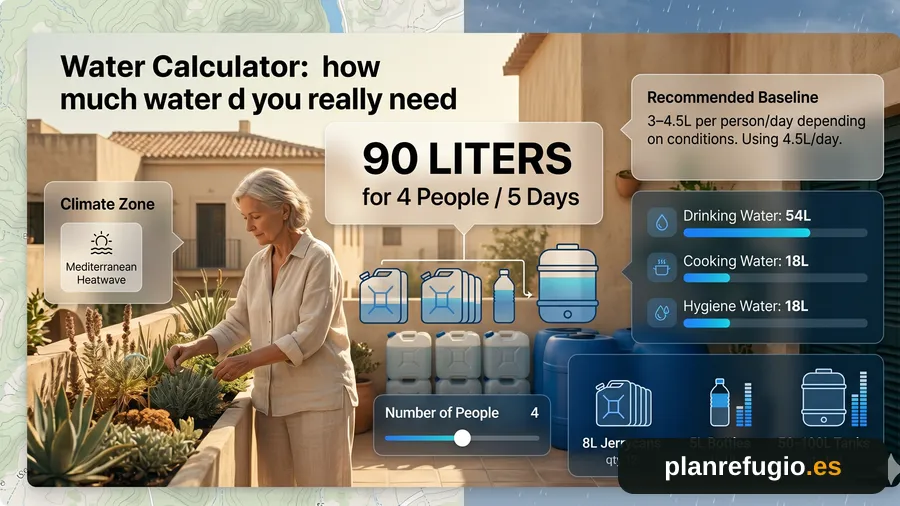
Water Calculator
Calculate how many gallons of water to store based on headcount, days, and climate zone.
Use calculator →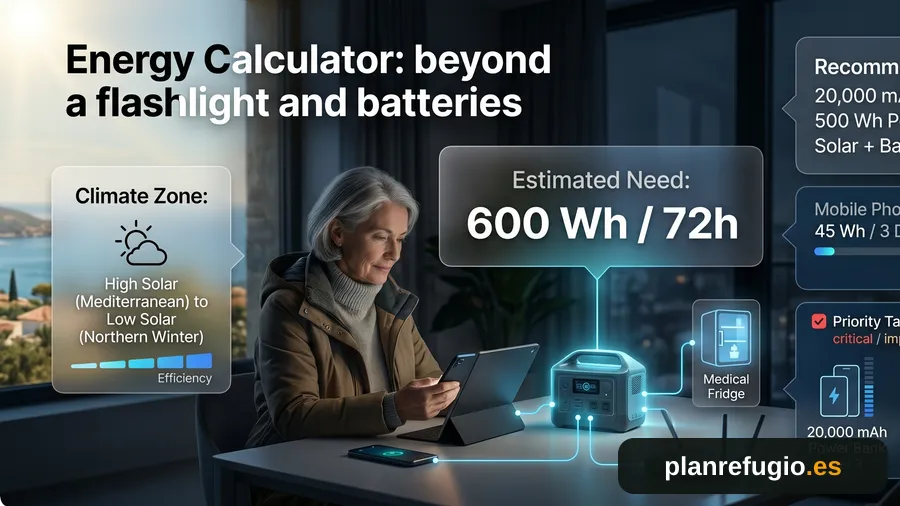
Energy Calculator
Estimate the flashlights, batteries, power banks, and solar panels you need for a blackout.
Use calculator →Water Calculator: how much do you really need
The standard recommendation from FEMA is one gallon per person per day for drinking and basic sanitation. But that figure changes with temperature, physical exertion, the presence of children or elderly family members, and the type of emergency. During a summer heat wave, daily water needs can reach 1.5 gallons per adult.
The EmergencyKitLab Water Calculator accounts for these factors: number of people, climate zone, emergency duration, and whether you have a filtration system available. The result includes both drinking water and cooking water, which many people forget to calculate.
A household of 4 in a warm climate preparing for a 5-day outage needs a minimum of 20 gallons of stored water. That specific calculation is exactly what the tool generates: not a generic estimate, but a precise amount for your actual situation.
Beyond quantity, the calculator recommends the most suitable storage format based on available space: stackable 2-gallon jugs for apartments with limited room, 5-gallon containers for greater flexibility, or 50-gallon drums for homes with storage space. Knowing the exact number before buying prevents both shortfalls and unnecessary spending.
Energy Calculator: beyond a flashlight and some batteries
A 72-hour blackout in winter affects far more than just lighting. The fridge, heating, water pumps in multi-story buildings, medications that need refrigeration, your phone charger for staying informed, and the router for communication: all depend on electricity. Calculating energy needs properly is more complex than it seems, and it is easy to either fall short or overspend on oversized equipment.
The EmergencyKitLab Energy Calculator analyzes your priority devices, their consumption in watt-hours (Wh), and expected hours of use. With that data, it recommends whether you need a basic 20,000 mAh power bank, a portable 500 Wh power station, or whether you should consider a solar-plus-battery system for longer autonomy.
The difference in needs is enormous: charging a phone for 3 days requires about 45 Wh; keeping a basic fridge running for the same period can need 600 Wh. Prioritizing which equipment is truly essential versus what would be nice to have completely changes the budget required.
The tool also factors in whether your area gets enough sunlight for solar recharging, which is especially relevant for sun-belt regions. In northern areas, the efficiency of solar panels in winter can be so low that a pre-charged power station or generator makes more sense.
Methodology: how EmergencyKitLab calculators work
EmergencyKitLab calculators are based on protocols published by FEMA (Federal Emergency Management Agency), the American Red Cross, CDC, and the World Health Organization for emergency situations. These standards have been adapted to the climatic conditions, housing types, and most frequent emergency patterns in the United States.
The calculation formulas are conservative by design: they are calibrated for the most demanding conditions of each scenario, not the average case. A plan that works in the worst case works in every case. The tools are updated when new data emerges from real emergencies.
If you want a complete plan that goes beyond water and energy, the Emergency Planner covers all categories: food, communication, first aid, documentation, and evacuation bags. The calculators are quick estimation tools; the planner generates a complete personalized plan.
Frequently asked questions about the tools
Are EmergencyKitLab calculators free?
Yes, all calculators and the emergency planner are completely free and registration-free. Use them as many times as you need for different scenarios.
What sources do the calculators rely on?
Formulas are based on FEMA, Red Cross, WHO and CDC protocols. Estimates are conservative by design.
What is the difference between the calculators and the planner?
Calculators are quick tools to estimate one category (water or energy). The full planner combines all categories into an integrated plan with shopping list and verified Amazon products.
Can I use the calculators for multiple people?
Yes. Both calculators let you input household size, climate zone and desired duration (up to 14 days).
When to use each tool
Water Calculator
Ideal if you already know you need to prepare but want to know exactly how many gallons to store. Useful for checking whether what you have at home is enough for your family.
Energy Calculator
Perfect if you are thinking about buying a power bank, portable station, or solar panels and want to know what capacity you really need before spending.
Full Planner
The most complete option if you want a comprehensive emergency plan with a shopping list, exact quantities across all categories, and verified product recommendations.